 Limited Stock
-
Lubrijoint 750 Tablet (Rs.586.8)
Composition: Glucosamine Sulfate Potassium Chloride (750mg)
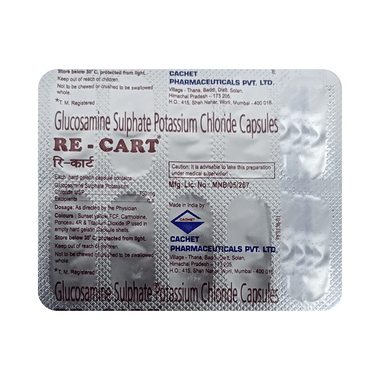
All Details About RE-Cart Capsule
Find out detailed description, uses, directions of use, side effects, warnings and precautions, frequently asked questions about RE-Cart Capsule
Description:
RE-Cart Capsule is a medicine used in the treatment of osteoarthritis. It helps in rebuilding the cartilage as well as provide relief from pain and swelling.RE-Cart Capsule can be taken with or without food. You should take it regularly and at a fixed time each day to get the maximum benefit from it. Do not stop taking the medicine even if you get better until the doctor tells you it is alright to stop. Along with taking the medicine, you should exercise regularly to strengthen muscles around the affected joint and manage your weight.
This medicine is generally well tolerated with little or no side effects. However, if you experience any symptoms which you think are caused by the use of this medicine, you should let your doctor know. Your doctor may help with ways to reduce or prevent these symptoms.
To make sure the medicine is safe for you, before taking this medicine, let your doctor know if you have any problems with your heart, kidneys, or liver. Also, tell your doctor about all the medicines you are taking. If you are pregnant or breastfeeding, you should consult your doctor before taking this medicine.
Uses:
Directions For Use:
Take this medicine in the dose and duration as advised by your doctor. RE-Cart Capsule may be taken with or without food, but it is better to take it at a fixed time.Side Effects:
Most side effects do not require any medical attention and disappear as your body adjusts to the medicine. Consult your doctor if they persist or if you’re worried about themOrdinary side effects of RE-Cart
- No common side effects seen
Warning & Precautions:
FAQs:
What is RE-Cart Capsule used for?
Who should not take RE-Cart Capsule?
Can RE-Cart Capsule affect my blood sugar if I have diabetes?
What serious problems should make me stop RE-Cart Capsule and call my doctor?
Are there people who need extra monitoring while taking RE-Cart Capsule?
Can RE-Cart Capsule make my cholesterol go up?
When can I expect relief after taking RE-Cart Capsule, and when should treatment be re-evaluated?
Written by:
Dr. T. Sharmila Krishna
M.B.B.S., MD (Biochemistry)
Reviewed by:
Dr. Sureshbabu Yadav
M.B.B.S., DIP.DIAB, F.R.S.H
Disclaimer:
Getomeds primary intention is to ensure that its consumers get information that is reviewed by experts, accurate, and trustworthy. The information and contents of this website are for informational purposes only. They are not intended to be a substitute for professional medical advice, diagnosis, or treatment. Please seek the advice of your doctor and discuss all of your concerns about any disease or medication. Do not disregard or postpone seeking professional medical advice because of something you read on Getomeds. Our mission is to support, not replace, the doctor-patient relationship.